The following dialogue happened with the moving guys who moved my stuff over to the UK.
“Please be careful with this box, it’s full of knives!”
“…?”
“Yeah, so many knives!”
“…”
“It’s quite heavy, because of the knives, I’m sorry!!”
Nervous laughter.
“Oh, I’m not a serial killer, I’m a chef!”
I love knives. I mean, seriously, I love knives and when I moved I put them all in one moving box and prayed the whole time the guys wouldn’t lose this box only or get stopped at the border.
I have about 25 different knives floating around my drawers, because can you really have enough?! Well, you’ll probably say yes, and… I will agree with you.
Technically you will need two knives to start your chefing journey, three tops. And although I really have a lot of knives, I will say: Quality over quantity. AND DON’T buy PORCELAIN KNIVES. You will drop them and then you will step in the shards and then you will cry and it’s not going to be pretty. Don’t buy glass chopping boards either, I have no idea who came up with it, but they were wrong.
My chopping board is from IKEA, I have it since I moved out and I love it dearly.
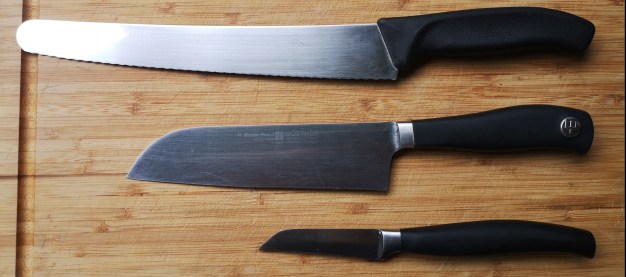
I’m going to talk you though my knives, their story, where you can get them and how often I use them. Aditionally I recommend a few other things that come in extremely handy when you’re cooking on a regular basis.
I don’t want to make this the beginning of every cooking book you’ve ever read, so I’m going with a bit more of a “how did I get this knife” approach.
We’re going from top to bottom and talk about other knives and helpful things last.
Top: “Victorinox Pastry Knife”, 26 cm and roughly 30 quid.
This knife is my first “proper” knife and I used to cut everything with it. It’s an ideal knife for beginners, as it forgives a lot, including being taken away by kitchen porters to thrown into the dishwasher (why? Just why!?!) or being used for hard crusts or bones. It has a fibrox handle and it’s easy to sharpen. This knife was actually a gift for me, after I made over 200 dishes on my own at a pub kitchen, my first head chef bought it for me. I was so so excited and in case he’s reading this: Kucki, I still have the knife. The only time I didn’t use it was during my very brief trip deep down into Michelin stared kitchens – it doesn’t have a straight blade and when you cut vegetables for a picky head chef, he will notice the wavy pattern and then he will throw away kilos of carrot cubes and that will make you cry and give you nightmares.
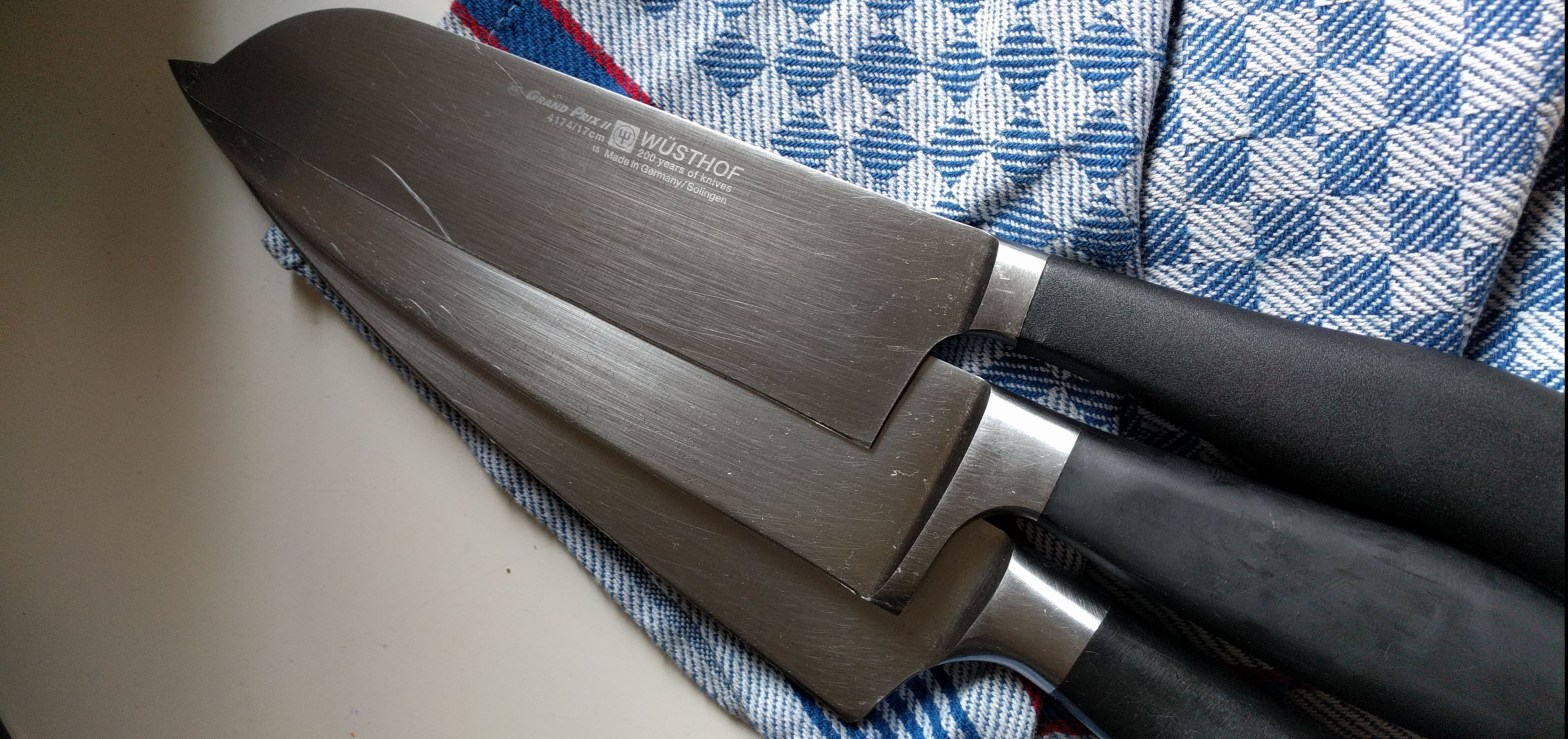
One down: “Wuesthof Santoku Knife” 17 cm and roughly 60 quid (which is too much, there is a newer version of it for £70, buy that one)
This is by far my favourite every day knife, I bought it for myself before I briefly moved to Ireland for work in 2012, I even have it tattooed on my arm – okay, with a mandala pattern, but still. Wuesthof is a German Company that I like very much, the knife is very sturdy and you can use it for absolutely anything. I highly recommend it, I absolutely love it. Everyday knives sometimes are a little bit heavy, this one isn’t. Especially beginner knives often come with a wide blade, which makes them hard to sharpen and dulls them much quicker.
Two down: “Zwilling four star vegetable knife”, 8 cm and £40 (but to be honest, I got it with a huuuuge discount with a cashback thing at my local supermarket at the time) – with a small vegetable knife, go with Victorinox again, because they are comparably cheap and are very good. Those are good for vegetable peeling and shaping, working with fruits and for cutting out black spots from potatoes. You don’t need need them, but they come in very handy every once in a while.
Additionally: “Zwilling Boning Knife” 14cm, £45
This one is not super necessary, but unless you’re a vegetarian, you will need them when you work with meat a lot, especially with meat on the bone or whole animals, such as chicken. This knife is very thin at the top and extremely sharp, therefore ideal to slide along a bone to remove it carefully, yet precisely. You could invest your money in a fish knife too, but you don’t necessarily need it. You won’t use a boning knife every day, but when you’ll need it, you’ll be happy to have bought it.
And this is the end of my little knife tour. This is all you need, but if you’re like me, not everything you will want.
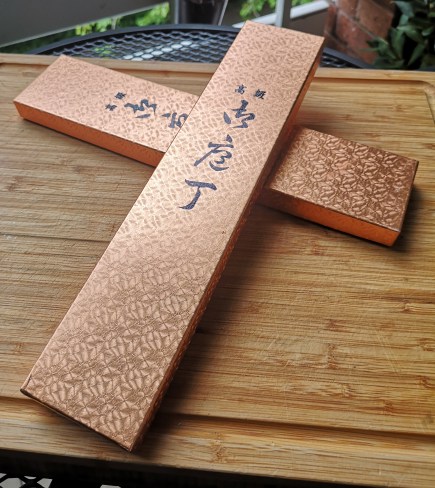
These knives are my babies. My husband got me the Japanese Santoku Knife as my christmas present and I was so excited I cried. It’s my knife. I love it dearly and it has replaced my Wuesthof knife the second I got to hold it for the first time. The steel used for the blade is very reconisable, because you can see all the 16 layers where the hot material has been folded and hammered. It holds a sharp edge much longer and it’s very hard. It’s so beautiful, isn’t it?
The other one (Nakiri) I only got last week, as an early birthday present. It’s a traditional vegetable preparation knife and I spent the weekend cutting things very thinly. 🙂 Both knives are handmade and hammered by hand. The style is called Tsuchime and the knives have wooden handles.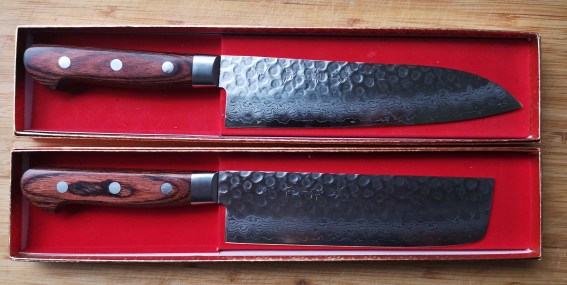
I don’t trust other people with my knives, as they ended up in the dishwasher far too often in my eary chef years, so I very rarely take the Japanese knives to work – and if I do I make sure they don’t leave my hand. Don’t be afraid of sharp knives by the way, it’s most likely to hurt yourself with a dull blade, as it’s harder to be precise and the possibility to slip is higher, as you will use more force to cut things.
 Other equipment (and the boning knife)
Okay, I’m going to be honest with you: Cooking is my LIFE. If there is a quirky thing I don’t have, I will buy it. Recently I saw an apple corer and although I cut my apples into quarters, I kind of needed it immediately.
I have an unnecessarily large number of tweezers, although I always plate with my fingers wearing gloves, I love electronic things that do fancy things, I love that we have a Vitamix, buuuut… the things I actually use are the three you see on the photo.
1. A Microplane. Costs vary, depending on the style you pick, but roughly between ten and twenty pounds. This is a fine grater, that I use for everything. If you follow my recipes, you’ll notice, that I use a lot (!) of lemon zest, I love garlic and all my recipes contain either lemon, garlic or ginger, preferably grated. But you can use the microplane for nutmeg, hard vegetables or spices and cheese too. Just make sure you’re careful with your fingertips, as it’s sharp. Also, you could put it in the dishwasher, but it will dull the blades. If you ever forget to wash it straight away, just let it soak in soapy water for a bit.
2. A rubber spatula. In professional kitchens you’ll hear less flattering names for it, usually referring to womens genitalia, so I kind of didn’t know their actual name, before I came to the UK. Kitchens are rough, especially when you’re female, but I have gotten used to it over time. Anyways, they are fantastic for scraping little bits from the corners of your pans, pots and bowls and I don’t want to miss them. You can buy a set of two or three nearly everywhere, I have at least three from IKEA.
3. Tweezers or tongs. Go with what you’re comfortable with, these are longer ones for the kitchen, but whatever you would like really. I have two of the bigger ones and a set of five small ones. You’ll need them to plate food, especially when you’re plating something delicate that you don’t want to touch or accidentally squeeze. Especially when you plate spaghetti or thin stripes of veg, you can wrap them around the tweezers, slightly open them and just slide them off.
 Just one last advice: Take care of your equipment. Wash and also dry your knives after you used them, don’t put them in the dishwasher, don’t cut citrus fruits with them and then leave them be (it will dull them), don’t drop them, don’t sharpen them with tinfoil, although people on pinterest do that and if in doubt, always ask a chef or find a youtube tutorial! Knives are meant to assist you your whole life, so invest in a good one.
I hope you liked my litte knife detour!
What knives do you like most?
 Jana Jarrett Nutrition
One thought on “knives … and other useful things”